
By Mark Quirk MSc CertLM
Healthspan Coach and Registered Health Coach in the NHS
Lifespan is simply how long we live. Healthspan is the period of our lives spent in good health, without significant disease or disability limiting what we can do.
Living longer is a remarkable achievement, but ideally, we want to extend healthspan alongside lifespan, adding healthy years to life, rather than simply years to life.
What does lifespan mean?
The average human lifespan has been increasing for years, so we’re living longer, but healthy life expectancy hasn’t kept pace. Using historical data, you can easily see the increase in lifespan. For example, data from the UK Office for National Statistics (ONS) show that in 1920 life expectancy for men was 55 years and for women 58 years, and in 2020 it was 79 years for men and 83 years for women [a] [1,2].
Lifespan, then, is simply how long we live, and we’ve seen great increases over the last hundred years.
What does healthspan mean?
As I mentioned above, healthspan is the period of our lives spent in good health, without significant disease or disability limiting what we can do.
Healthspan isn’t a precisely standardised statistical measure. The ONS publishes two datasets: one measures healthy life expectancy and the other disability-free life expectancy, which aren’t identical concepts.
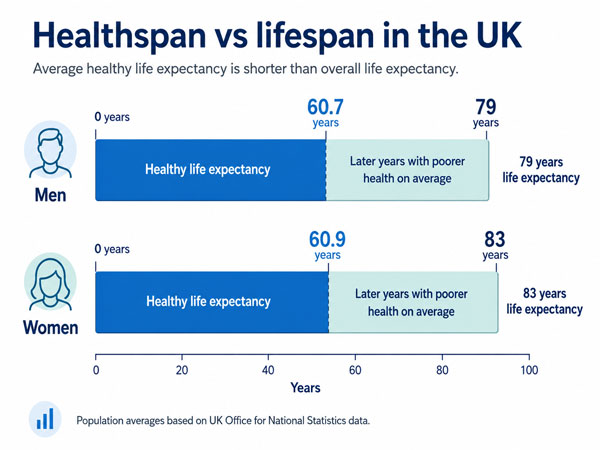
Healthy life expectancy is based on an individual’s self-assessment of being in very good or good health, with averages of 60.7 years for men and 60.9 years for women, using the latest data [3]. Whereas the disability-free life expectancy estimates how long a person spends free from a limiting long-term illness or disability [4], which adds a couple of years, to around 63 years (though the latest data here was published in 2016). Both help us estimate the gap between how long people live and how long they live in good health.
Healthspan vs lifespan in the UK
Using healthy life expectancy, we’re looking at just over 60 years for both men and women. At population level, that leaves a gap of roughly two decades between average healthy life expectancy and overall life expectancy [3]. If it sounds frightening, bear in mind that it doesn’t predict your lifespan or healthspan, it’s not that everyone suddenly becomes unhealthy at 61. These are population averages rather than a prediction of an individual’s health trajectory. And critically, for most of us there are things we can do to improve the odds of spending more of our later years in good health.
Why is healthspan shorter than lifespan?
Much of the gap between healthspan and lifespan reflects the increasing burden of chronic disease and disability as we get older.
Age itself is an important risk factor, but ageing doesn’t make every chronic disease inevitable. The risk or timing of many common conditions, including cardiovascular disease and type 2 diabetes, is influenced by modifiable factors.
Can we increase our healthspan?
We can’t guarantee how long we’ll remain healthy; genetics, chance, environment, and circumstances all play their part. But, many of the risk factors for the chronic diseases that shorten healthy life are modifiable. Large prospective studies have found that combinations of healthier behaviours are associated not only with longer life, but with more years lived free of major chronic diseases.
For example, a large prospective study published in The BMJ in 2020 [5] found that, at age 50, people with four or five low-risk lifestyle factors – never smoking, a healthy body weight, regular physical activity, moderate alcohol consumption and a higher-quality diet – were estimated to live around 8–10 more years free of cancer, cardiovascular disease and type 2 diabetes than people with none of these factors.
A second 2020 study [6], using longitudinal data from England and the United States, found a similar pattern. At age 50, people with none of four behavioural risk factors – smoking, physical inactivity, obesity and the study’s measure of alcohol consumption – could expect to live up to 11 years longer without disability and up to 12 years longer without chronic disease than those with two or more risk factors.
Six ways to support a longer healthspan
How do we get there? Rather than looking for a single anti-ageing intervention, the strongest evidence, including those mentioned above [5,6], points towards getting the fundamentals right, which is where my pillars of healthspan come in. In summary:
- Eat a high-quality diet and maintain a healthy body composition
- Stay physically active and maintain muscle strength
- Prioritise quality sleep
- Manage chronic stress and use emotional skills to your advantage
- Invest in supportive relationships
- Plus, minimise harmful things, like smoking and excess alcohol
You can read more about my pillars of healthspan here.
Extending healthspan: compression of morbidity
One way of thinking about a longer healthspan is through the concept of compression of morbidity: delaying the onset of significant disease and disability so that ill health occupies a smaller proportion of our lives.
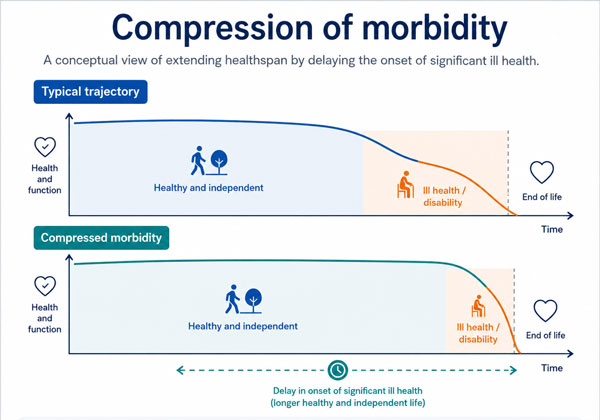
We can’t know how much any individual can extend their healthspan, and living healthily doesn’t guarantee a disease-free old age. But many of the major contributors to cardiovascular disease, type 2 diabetes, some cancers and loss of physical function are modifiable.
The goal, therefore, isn’t immortality or perfect health. It’s to improve the odds of remaining healthy, independent and able to do the things that matter to us for as long as possible.
What do you do now that you hope you can still do at age 80 (or older)? Do you enjoy travelling, driving, doing your own shopping, visiting family, or perhaps you have or expect to have grandchildren or great-grandchildren you’d like to be able to play with? Our healthspan is our most enabling or limiting factor.
Death, as they say, is one of two inevitable aspects of life (taxes being the other, of course). The aim isn’t to avoid ageing or guarantee a disease-free life, but to improve our chances of staying capable, independent, and engaged for as long as possible. That’s what taking an active approach to healthspan is all about.
Healthspan FAQs
What does healthspan mean?
Healthspan is the period of our lives spent in good health, without significant disease or disability limiting what we can do
What’s the difference between healthspan and lifespan?
Lifespan is how long we live; healthspan is how long we live in good health. Put another way, lifespan is about adding years to life, while healthspan is concerned with adding healthy life to those years.
What is the average healthspan in the UK?
The ONS publishes two datasets, one measuring healthy life expectancy and the other disability-free life expectancy.
Healthy life expectancy is based on an individual’s self-assessment of being in very good or good health, with averages of 60.7 years for men and 60.9 years for women, using the data available in 2026 [3]. Whereas the disability-free life expectancy estimates how long a person spends free from a limiting long-term illness or disability [4], which adds a couple of years, to around 63 years.
Can healthspan be increased?
There are no guarantees, but many of the major causes of premature death and disability, including cardiovascular disease and type 2 diabetes, can be prevented or delayed through how we live our lives, which I summarise in my pillars of healthspan.
References
[1] Office for National Statistics, National life tables – life expectancy in the UK: 2022 to 2024 (2025)
https://www.ons.gov.uk/peoplepopulationandcommunity/birthsdeathsandmarriages/lifeexpectancies/articles/mortalityinenglandandwales/pastandprojectedtrendsinaveragelifespan
[2] Office for National Statistics, Mortality in England and Wales: past and projected trends in average lifespan, (2022).
https://www.ons.gov.uk/peoplepopulationandcommunity/birthsdeathsandmarriages/lifeexpectancies/articles/mortalityinenglandandwales/pastandprojectedtrendsinaveragelifespan
[3] Office for National Statistics, Healthy life expectancy, UK: between 2011 to 2013 and 2022 to 2024 (2026)
https://www.ons.gov.uk/peoplepopulationandcommunity/healthandsocialcare/healthandlifeexpectancies/bulletins/healthstatelifeexpectanciesuk/between2011to2013and2022to2024
[4] Office for National Statistics Disability-Free Life Expectancy by Upper Tier Local Authority: England 2012 to 2014 (2016)
https://www.ons.gov.uk/peoplepopulationandcommunity/healthandsocialcare/healthandlifeexpectancies/bulletins/disabilityfreelifeexpectancybyuppertierlocalauthority/england2012to2014
[5] Li Y et al. 2020 Healthy lifestyle and life expectancy free of cancer, cardiovascular disease, and type 2 diabetes: Prospective cohort study. The BMJ 368, 1–10. (doi:10.1136/bmj.l6669)
[6] Zaninotto P, Head J, Steptoe A. 2020 Behavioural risk factors and healthy life expectancy: evidence from two longitudinal studies of ageing in England and the US. Sci Rep 10. (doi:10.1038/s41598-020-63843-6)
Article updated, August 2026
[a] using Period age at death which is the most pessimistic way of looking at life expectancy, see for ONS for other ways to use the statistics.