

Why being kinder to yourself can help you make lasting changes to your health and habits.

By Mark Quirk MSc CertLM, Healthspan coach and Registered Health Coach
I used to believe being hard on myself was a useful way to drive change. If I was often late, wasn't exercising enough, or had developed a habit I didn't particularly like, surely being thoroughly fed up with myself would provide the motivation to do something about it?
I'm always late! I really need to lose some weight! I'm rubbish at sticking to things!
Sound familiar?
I've since learned that giving myself a hard time rarely helps. And that a more constructive starting point is acceptance.
Now, if you're anything like I used to be, that might sound counterintuitive. Surely accepting something you don't like is the very opposite of changing it? Aren't you just letting yourself off the hook?
Not quite.
Acceptance doesn't mean approval
There's an important distinction between accepting something and approving of it.
Acceptance simply means acknowledging how things are right now, without adding unnecessary judgement or criticism.
I can accept that I'm not as physically active as I'd like to be. That's where I am today. It doesn't mean I'm delighted about it, or that I've decided to spend the rest of my life on the sofa.
Accepting where you are doesn't mean deciding to stay there.
In fact, acceptance can be an especially useful starting point for making changes.
Why being hard on yourself can get in the way
For a long time, I thought self-criticism was an important source of motivation. If I felt sufficiently bad about something, surely, I'd be more determined to change it.
And sometimes that does work, at least in the short term. Frustration or dissatisfaction can sometimes prompt us to act.
But there's a difference between recognising that something needs to change and turning that recognition into an attack on ourselves.
Consider the difference between these two thoughts:
I'm hopeless. I have absolutely no willpower. Why can't I ever stick to an exercise routine?
And:
I haven't managed to exercise as regularly as I'd like. I wonder what's getting in the way, and what I could do differently?
Both acknowledge exactly the same situation. Neither pretends that everything is fine.
But the first makes the problem about who you are. The second makes it about something you're doing, and potentially something you can change.
A growing body of research examines self-compassion, which broadly means treating ourselves with the same understanding and encouragement we might offer a good friend.
Research has found that people with greater self-compassion tend to report less stress, more health-promoting behaviours, and fewer health-risk behaviours [1]. That doesn't prove self-compassion causes healthier behaviour, but it does challenge the idea that we need to beat ourselves up to make positive changes.
Being kind to yourself doesn't mean having low standards. You can care deeply about improving your health while accepting that you're an imperfect human being.
Fortunately, most of us fall into that category.
From self-judgement to problem-solving
Another reason I think acceptance is so useful is that it can help us move from self-judgement to constructive problem-solving.
When we're caught up in anxiety, frustration, or harsh self-criticism, it can become harder to step back, consider alternatives, and find a helpful way forward.
And changing established habits often requires exactly that sort of flexible thinking.
Let's imagine you've decided to exercise three times a week. You're enthusiastic, you know it will benefit your health, and you've even bought some new trainers.
The first week goes brilliantly.
By week three, work has become hectic, family commitments have multiplied, and your trainers are spending more time in the cupboard than you'd intended.
You could berate yourself for your lack of discipline. Perhaps resolve to try harder next Monday.
Or you could accept what's happened and become curious about it.
Was three sessions realistic? Would shorter sessions work better? Could I exercise in the morning? Is there something I could change about my routine to make it easier?
Notice what's happened.
You haven't lowered your standards or abandoned your goal. You've simply stopped treating yourself as the problem and started looking for a better solution.
That's a much more useful place from which to make a change.
Notice, accept, choose
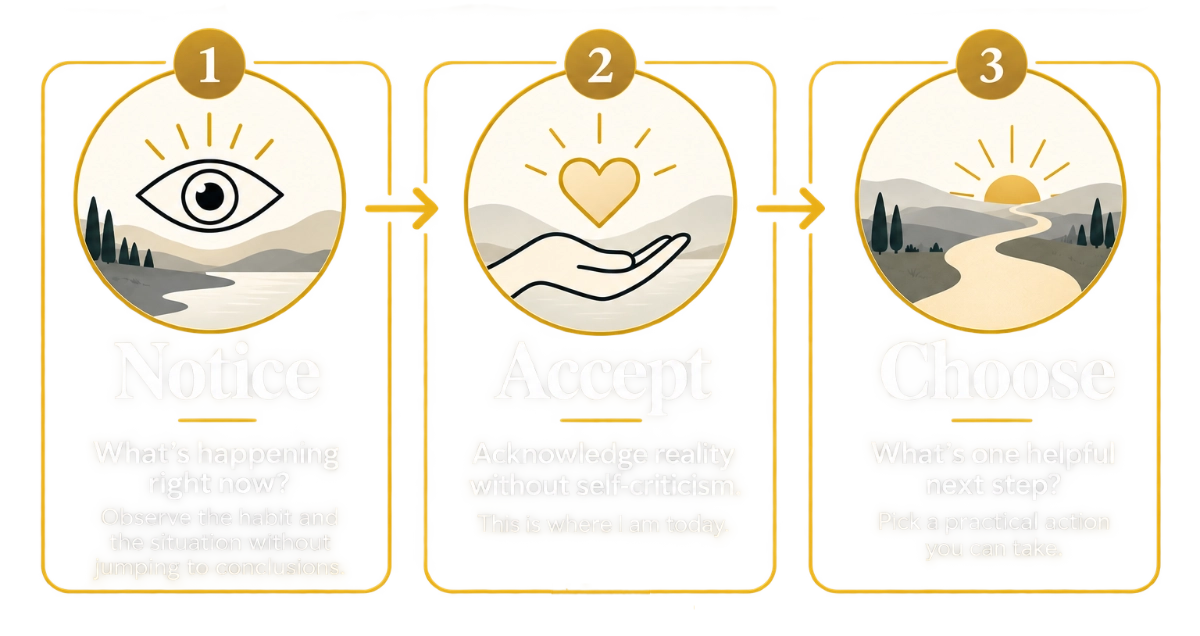
One way to put this into practice is a simple three-step approach.
- Notice
Start by recognising what's actually happening, rather than what you think should be happening.
Perhaps you're regularly eating more in the evening than you intend, finding it difficult to get enough sleep, or struggling to fit movement into your day.
Try to notice the behaviour and the circumstances surrounding it, without immediately jumping to conclusions about what it says about you.
- Accept
Acknowledge that this is where you are right now.
You don't have to like the situation, and acceptance doesn't mean that disappointment or frustration will magically disappear.
It simply means recognising reality without adding unnecessary self-criticism.
You might remind yourself: This is where I am today. It doesn't define me, and I can choose what to do next.
- Choose
Now ask yourself what you'd like to do differently.
Do you genuinely want to change this? If so, what's one practical adjustment that might help?
Perhaps it's changing your evening routine, putting your walking shoes by the front door, or choosing a smaller, more manageable first step.
And if your first attempt doesn't work? Well, that's useful information too. You can learn from it and try another approach.
After all, lasting behaviour change is rarely about finding enough willpower to force yourself into submission. It's often about developing habits, routines and environments that make healthier choices easier.
You can accept reality and still want to change
There's something liberating about recognising that we don't have to dislike ourselves, or our present circumstances, to want something different.
We can accept our current fitness while working to become stronger. We can accept our eating habits while exploring healthier alternatives. We can accept that we're sometimes overwhelmed while learning better ways to manage stress.
And we can take responsibility for our choices without treating every setback as evidence of personal failure.
This doesn't mean acceptance automatically makes change easy. Difficult choices, uncomfortable feelings, and effort may still be involved.
But perhaps we can put that effort into making useful changes, rather than into making ourselves miserable.
You don't have to dislike yourself to want to improve yourself.
Accepting where you are today doesn't mean giving up on tomorrow. And removing some of the unpleasant emotion can help create a little more room for curiosity, creativity, and the choices that help us move forward [2].
And if we can make positive changes to our health without giving ourselves such a hard time along the way, that sounds like a pretty good deal to me.
Acceptance rocks!
References
1. Liu J, Conner M, Lainidi O, Yu S, O’Connor DB. 2026 Self-compassion, stress and health behaviour: a systematic review and meta-analysis. Health Psychol Rev , 1–18.
2. Baas M, de Dreu CKW, Nijstad BA. 2008 A meta-analysis of 25 years of mood-creativity research: Hedonic tone, activation, or regulatory focus? Psychol Bull 134, 779–806.